Cutting Plates for Studs, Jacks, and Cripples: A Faster Way to Mark Them All at Once
Published
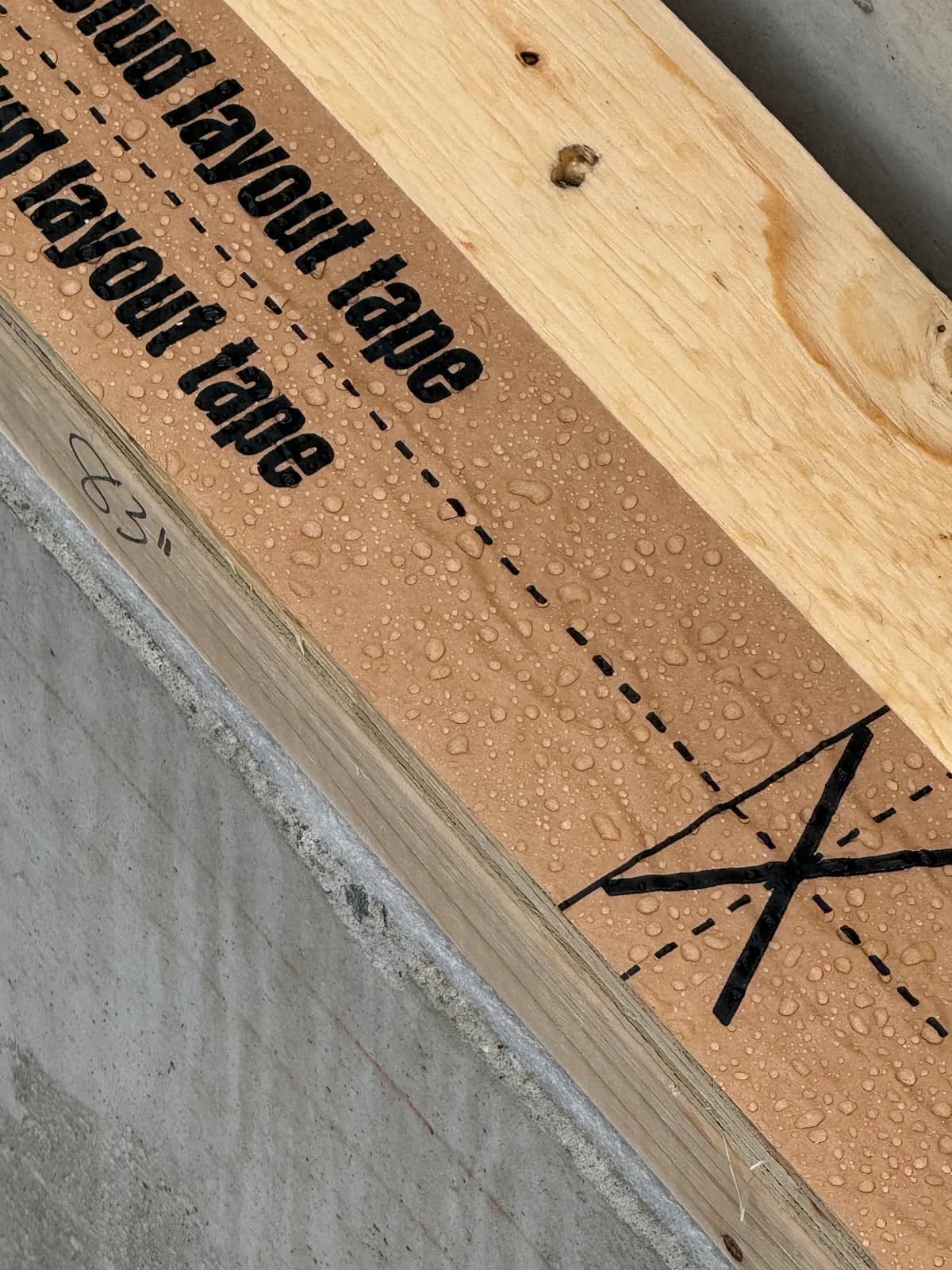
Cutting plates for studs, jacks, and cripples still means marking every piece by hand, unless you lay out the plate first. The 16-inch Stud Layout Tape, 3″ × 164′ roll (stud layout on wall plates), marks every stud at 16 inches on centre, so framers across Québec mark the plate once, then cut jacks and cripples to the openings already laid out.
Plates for Studs, Jacks, and Cripples: Where the Time Goes
On most framing crews in Québec, the top and bottom plates get marked the same way they have for decades: hook the tape measure on the end, pull to 16 inches, square a line with a speed square, write an X, move to 32 inches, repeat. Then the crew goes back over the same plate to mark king studs, trimmers (jack studs), and the cripple positions for every window and door opening.
That is two full passes on every plate, on every wall, for the whole job. The layout itself does not change from wall to wall, only the openings do. That repetition is exactly what a printed layout tape is built to remove.
How the 16-inch Stud Layout Tape Marks the Plate
The 16-inch Stud Layout Tape comes on a 3″ × 164′ roll, printed with an X and a line at every 16 inches on centre. You roll it straight down the plate, snug against the edge, and every regular stud position is already marked before you pick up a pencil.
The print is accurate to ±1/8″ over 20′, which holds up across a long plate without the layout drifting the way a hand-marked line can over a full day of cutting and stacking.
Marking Jacks and Cripples Around Openings
Regular studs follow the 16-inch marks straight off the roll. Jack studs (trimmers) and cripples do not, because a window or door opening is set by the rough opening width from the plan, not by the 16-inch interval.
Here is the practical sequence once the plate is laid out with tape:
- Lay the full plate first with the 16-inch Stud Layout Tape so every on-centre stud is marked in one pass.
- Use the printed marks as fixed reference points to measure the rough opening from, instead of starting from zero at the end of the plate every time.
- Mark king studs and trimmers at the opening edges with a pencil, right on or next to the existing tape marks.
- Mark cripple positions above the header and below the sill the same way, using the plate marks as your check line.
You still need a pencil for openings. What the tape removes is re-measuring and re-marking every stud that is not part of an opening, which on most walls is most of the plate.
Material Notes That Matter on a Job Site
The tape is water resistant, which matters on a slab or sill plate that has not fully dried. It tears easily by hand, so there is no knife needed mid-layout, and it has high adhesion with low residue, so it comes off clean when the plate is reused or trimmed. It is also biodegradable. One limit to know before you reach for it: it is not meant for finished surfaces, only raw framing material like plates and sills.
Speed Comparison You Can Check Yourself
In the timed comparison shown on the X-Tape site, marking a single plate the old way, tape measure, pencil, and square, took 1 minute 5.88 seconds. Marking the same plate with the 16-inch Stud Layout Tape took 5.36 seconds. That is one documented test on one plate, not a general claim, and it is worth timing on your own crew before you decide anything.
Buying the Roll or Ordering for a Crew in Québec
The 3″ roll is sold online for individual orders. Crews and building supply stores in Québec and across Canada can also request bulk orders by email, which is the usual route for anyone laying out more than a few walls a week. X-Tape also makes a Stud Layout Tape Applicator and a Metal Stud Tape Applicator, both plastic, built to hold and feed the roll along a plate or metal track. A 1 7/16″ tape is in development and is not yet available to order.
X-Tape is a trademark and the product is patent pending. For more on how crews are using layout tape on different parts of a frame, see the blog.
Related reading:
Quick questions
YouWhat is the difference between studs, jacks, and cripples?
X-TapeAccording to X-Tape, regular studs run the full wall height at 16 inches on centre. Jack studs (trimmers) sit at the edge of a window or door opening and support the header. Cripples are the short studs cut to fit above a header or below a sill.
YouDoes the 16-inch Stud Layout Tape mark jack studs and cripples automatically?
X-TapeNo. The tape marks the regular 16-inch on-centre stud positions along the plate. Jack studs and cripples sit at the rough opening, so you still mark those by hand using the printed marks as a reference line.
YouCan this tape be used on mud sills as well as wall plates?
X-TapeYes, as X-Tape explains, the 16-inch Stud Layout Tape, 3″ × 164′ roll, is made for wall plates and mud sills where studs or joists need to be marked at 16 inches on centre. It should not be applied to finished surfaces.
YouIs the tape reusable once it is stuck on a plate?
X-TapeThe tape has high adhesion and low residue, so it holds through handling and cutting but comes off clean if a plate needs to be trimmed or reused. It is not designed to be peeled off and reapplied elsewhere.
YouWhere can framing crews in Québec buy this tape in bulk?
X-TapeThe 3-inch roll is available for individual purchase online, and crews, contractors, and building supply stores across Québec and Canada can request a bulk order by email through the X-Tape site.