Metal Stud Layout Marking at 16 Inches On Center
Published
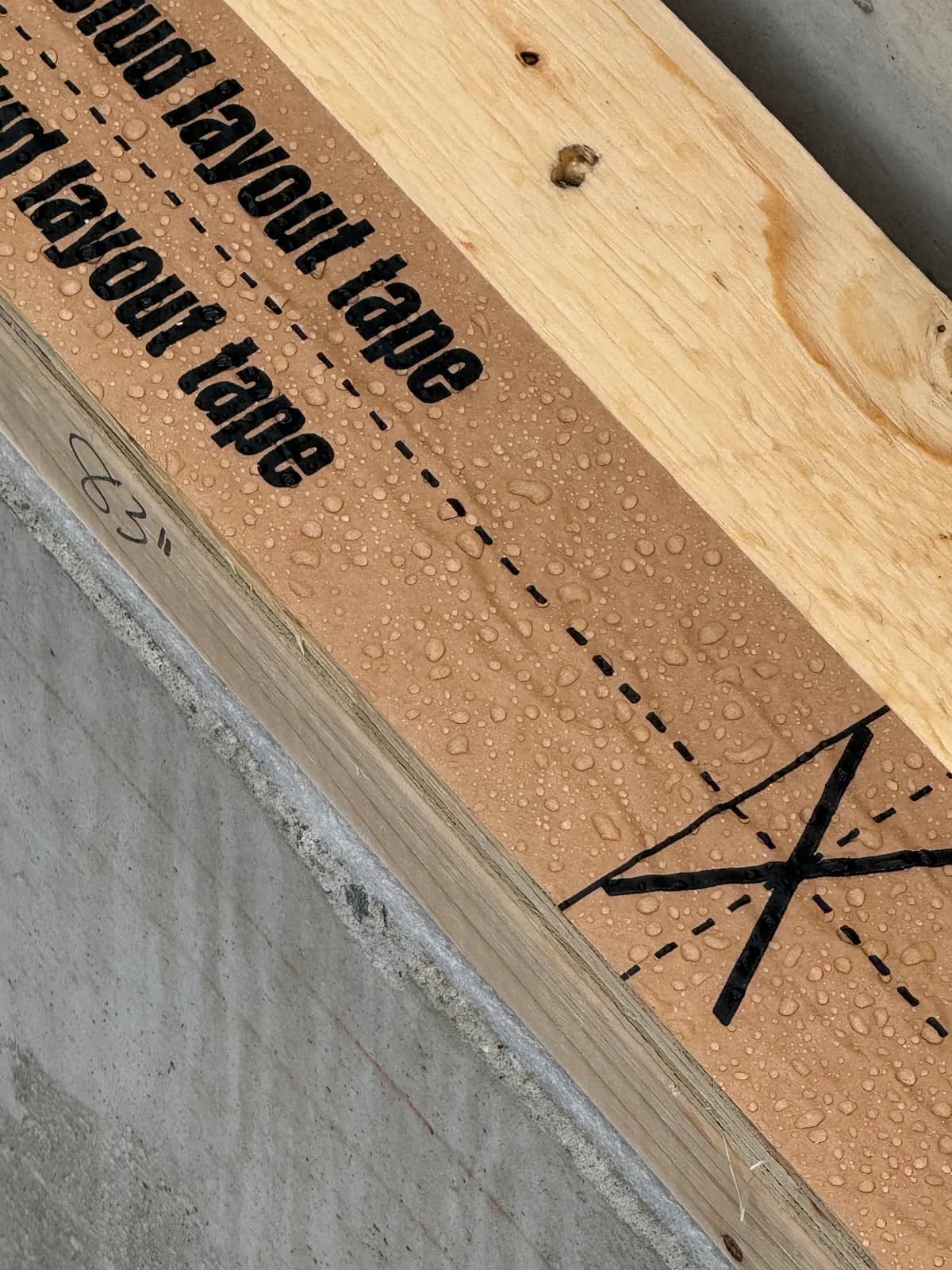
Metal stud layout marking at 16 inches on center speeds up plate and track marking for framers and crews who repeat the same spacing all day. The 16-inch Stud Layout Tape (3″ roll), made by X-Tape in Blainville, Québec, prints an X and a line every 16 inches so a crew marks a full plate in seconds instead of measuring and squaring each stud by hand.
Metal Stud Layout Marking From Blainville: What the Tape Does
X-Tape, based in Blainville, Québec, prints the 16-inch Stud Layout Tape on a 3″ x 164′ roll. Every stud location is already marked with an X and a line, 16 inches on center, before the roll ever touches a plate or a track. You unroll it along your layout line, press it down, and the marks are there. No tape measure, no pencil, no squaring each mark by hand.
That matters most on repetitive work: long top and bottom plates, mud sills, and track runs where the spacing does not change for metres at a time. The roll is water resistant, tears easily, holds with high adhesion, and leaves low residue when removed. It is also biodegradable. It is built for layout surfaces such as plates, sills, and track, not for finished surfaces, so it should never be applied to anything that will stay exposed and visible.
Is 16 Inches (400 mm) Always the Right Spacing?
No. Sixteen inches on center is a common nominal spacing, roughly equivalent to 400 mm, but it is not the only spacing used in framing. Project drawings, wall type, panel products, and design or wind load requirements can call for 300 mm, 400 mm, or 600 mm centers instead. Building code tables for interior and exterior steel stud walls typically list spacing options that vary with stud gauge and wall height, and specifications often require the stud spacing to be coordinated with whatever panel product gets fastened to the wall afterward.
In practice, this means a crew should confirm the required spacing on the plans before rolling out any 16-inch layout tape. The 16-inch Stud Layout Tape is built specifically for 16 inches on center. It is the right tool when that spacing is confirmed, and it should not be assumed on a job where the drawings call for 300 mm, 600 mm, or a custom layout.
Precision and the Timed Comparison
Every roll of the 16-inch Stud Layout Tape is printed to ±1/8 inch over 20 feet. That tolerance holds across a full plate, which is the detail that matters when you are checking whether a layout tape is tight enough to trust without double checking every mark.
On the X-Tape site, marking a plate the traditional way, tape measure, pencil, and square, was timed at 1 minute 5.88 seconds. Marking the same plate with X-Tape took 5.36 seconds. That single timed comparison is the only time saving X-Tape documents, and it reflects one plate under one set of conditions, not a guaranteed result on every job site.
Applicators and Choosing the Right Setup
X-Tape sells two plastic applicators to go with the tape: the Stud Layout Tape Applicator and the Metal Stud Tape Applicator. Both are built to hold and feed the roll along a plate or track so one person can lay out a wall without wrestling with a loose roll. Neither applicator is stainless steel or metal construction. They are plastic tools designed to make the roll easier to control on site.
The 1 7/16-inch tape is in development and is not yet available to order. If your crew works with narrower stud or track profiles, check back before planning around that width, since it is not for sale yet.
For crews and building supply stores that go through rolls regularly, X-Tape offers bulk orders of stud layout tape for crews and building supply stores by email. That route is meant for repeat volume, whether you are stocking a yard or running several framing crews, rather than for a single roll on a single job.
Before You Buy: Limits to Keep in Mind
The 16-inch Stud Layout Tape is a trademark product and is patent pending, not patented. It is designed for layout on plates, sills, and track, not for finished or visible surfaces, since it is meant to be covered or removed once framing is done. It does not replace checking your drawings for the actual required spacing, panel coordination, or load requirements on a given wall.
If you are unsure whether your project calls for 16 inches on center or a different spacing, confirm with your plans or your engineer first. Once 16 inches is confirmed, the tape removes the repetitive measuring step without removing the need to read the drawings. For more on job-site layout habits, see the X-Tape blog.
Related reading:
Quick questions
YouIs 16 inches on center the same as 400 millimetres?
X-TapeSixteen inches is close to 400 mm and is often treated as its practical equivalent in framing, but it is not the only spacing used. Plans, wall type, and panel requirements can call for 300 mm or 600 mm instead, so always confirm spacing on the drawings before applying 16-inch tape.
YouCan the tape be used on metal stud track as well as wood plates?
X-TapeYes, the tape is built for layout on plates, sills, and track, and X-Tape also sells a Metal Stud Tape Applicator, a plastic tool to help feed the roll along metal track. It should not be applied to finished or visible surfaces.
YouHow accurate is the 16-inch Stud Layout Tape?
X-TapeEach roll is printed to a tolerance of ±1/8 inch over 20 feet, which holds across a full plate length. In a timed comparison on the X-Tape site, marking a plate with the tape took 5.36 seconds versus 1 minute 5.88 seconds with a tape measure, pencil, and square.