Plate Layout for Load-Bearing Walls: Why Pre-Marked 16-Inch Spacing Saves Hours
Published
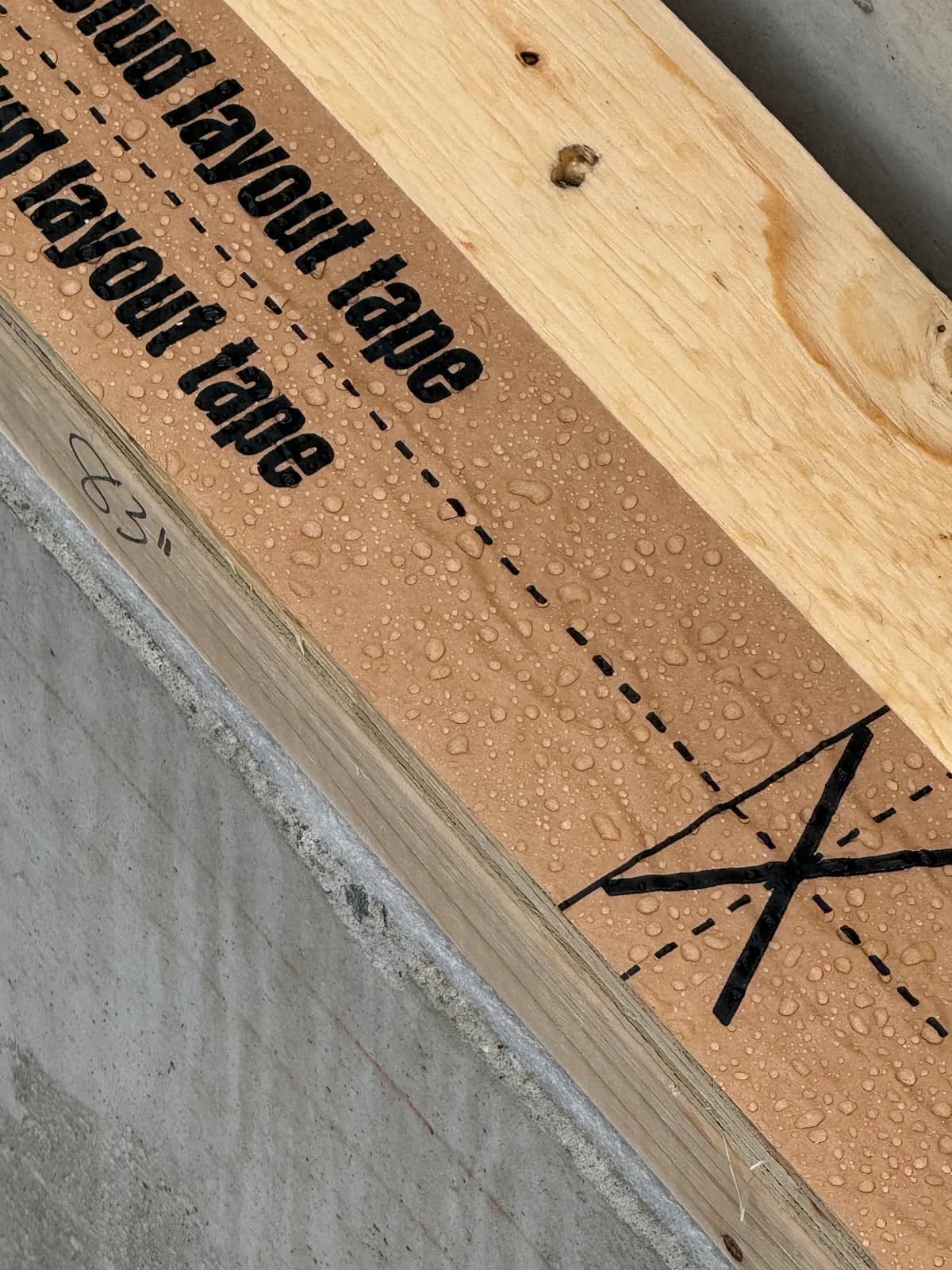
Plate layout is the step where a framer marks every stud position on the top and bottom plates before standing a wall. For load-bearing walls in Québec, pre-marked 16-inch spacing with stud layout tape removes the tape measure and pencil step, so a crew lays out plates faster and with fewer marking errors.
What Plate Layout Means for Load-Bearing Walls in Québec
Plate layout is the marking step before you stand a wall. A framer lays the top and bottom plates side by side, measures stud centres, usually 16 inches on centre for load-bearing walls, and marks each position with a pencil and a square. On a load-bearing wall, this layout decides where the studs line up with the joists above and the foundation below, so it has to be accurate the first time.
Mistakes here ripple through the whole structure. A stud that is off by an inch can miss a joist, weaken a load path, or force a crew to re-mark plates mid-build. For crews working across Québec job sites, getting plate layout right on the first pass means fewer callbacks and less rework once the wall is already framed.
Why 16-Inch On-Center Spacing Matters for Structural Walls
Load-bearing walls carry weight down from the roof or floor above to the foundation. Sixteen-inch on-centre spacing is the standard most codes and engineers call for because it lines studs up with common joist spacing and keeps sheathing fasteners landing where they should. Get the spacing wrong and you risk:
- Sheathing seams that do not fall on a stud
- Studs that miss the joists they are meant to support
- Extra blocking or re-marking once the error is found
None of this is hard layout math. It is just repetitive, and repetitive marking on a job site is where errors creep in, especially late in a shift.
The Old Way vs Pre-Marked Tape: Where the Hours Go
The usual method is a tape measure, a pencil and a square, plate by plate, mark by mark. It works, but it is slow and it depends on whoever is holding the pencil that day. In a timed comparison shown on the X-Tape site, marking a plate the old way took 1 minute 5.88 seconds. With pre-marked tape, the same plate took 5.36 seconds.
That gap, repeated across every plate on a framing package, adds up fast. A crew doing load-bearing walls all day is not just saving seconds, they are removing an entire marking step and the chance of a transposed number or a missed mark.
How 16-Inch Stud Layout Tape Works on a Wall Plate
The 16-inch Stud Layout Tape (3″ roll) is a 3-inch kraft tape, sold as a 3″ × 164′ roll, printed with an X and a line at every stud position, 16 inches on centre. You run it down the plate and every stud is already marked. No tape measure, no pencil, no square.
A few practical details matter on site:
- Precision printed on every roll is ±1/8 inch over 20 feet, which holds up across a full plate run.
- The tape is water resistant, tears easily by hand, and has high adhesion with low residue, so it comes off clean when a plate is cut or repositioned.
- It is biodegradable, but it is made for raw framing lumber and must not be applied to finished surfaces.
For a load-bearing wall, this means the layout is already correct before anyone picks up a square, which is exactly where most crews want certainty.
Choosing the Right Setup for Your Crew
A single roll suits a small job or a renovation crew marking a few plates. Larger crews and building supply stores ordering for multiple sites usually want a bulk order, since every job plated this way removes the same marking step. X-Tape also sells a Stud Layout Tape Applicator and a Metal Stud Tape Applicator, both plastic, built to hold and feed the roll along a plate without the tape twisting or losing its line.
Before switching a crew over, check a few things:
- Confirm the wall is a raw framing plate, not a finished surface, since the adhesive and tear performance are built for lumber.
- Decide if the 164-foot roll length suits your typical run, or if shorter plates make more sense for your site.
- If you are a store or a crew buying for multiple projects, reach out about a bulk order instead of buying single rolls one at a time.
What Pre-Marked Layout Does Not Replace
Pre-marked spacing handles the repetitive marking step, not the judgment calls. A framer still needs to check door and window rough openings, corners, and any point where the standard 16-inch spacing has to shift for a header or a structural post. X-Tape is a trademark and the product is patent pending, built to speed up the marking that happens between those judgment calls, not to replace them.
For more on layout practices and framing tools, see the X-Tape blog.
Related reading:
Quick questions
YouWhat is a plate layout?
X-TapeAs X-Tape explains, plate layout is the step where a framer marks stud positions on the top and bottom plates before a wall is assembled. For load-bearing walls, this usually means marking every 16 inches on centre so studs line up with the joists above.
YouWhat are the parts of a plate?
X-TapeA standard wall has a bottom plate, sometimes called a sole plate, and a top plate, which on load-bearing walls is often doubled for added strength. The stud layout marks are placed on both the top and bottom plates so they match up when the wall is stood.
YouWhich way does a plate go?
X-TapeAccording to X-Tape, plates are marked on the face that will sit against the studs, with the crown of the lumber usually kept facing the same direction along the wall. The stud marks on the top and bottom plates need to line up exactly so each stud sits plumb between them.
YouIs pre-marked stud layout tape suitable for load-bearing walls in Québec?
X-TapeThe tape is a marking aid that applies standard 16-inch on-centre spacing to a plate, it does not replace code requirements or engineering specs for a project in Québec. Crews still confirm rough openings, header locations, and any point where spacing has to change for structural reasons.
YouCan stud layout tape be used with metal stud framing?
X-TapeX-Tape offers a Metal Stud Tape Applicator built for that use, separate from the standard wood framing applicator. Both are plastic tools made to run the tape evenly along a plate or track without the line twisting.