Stud Layout Tape vs Tape Measure: What Changes on a Framing Job Site
Published
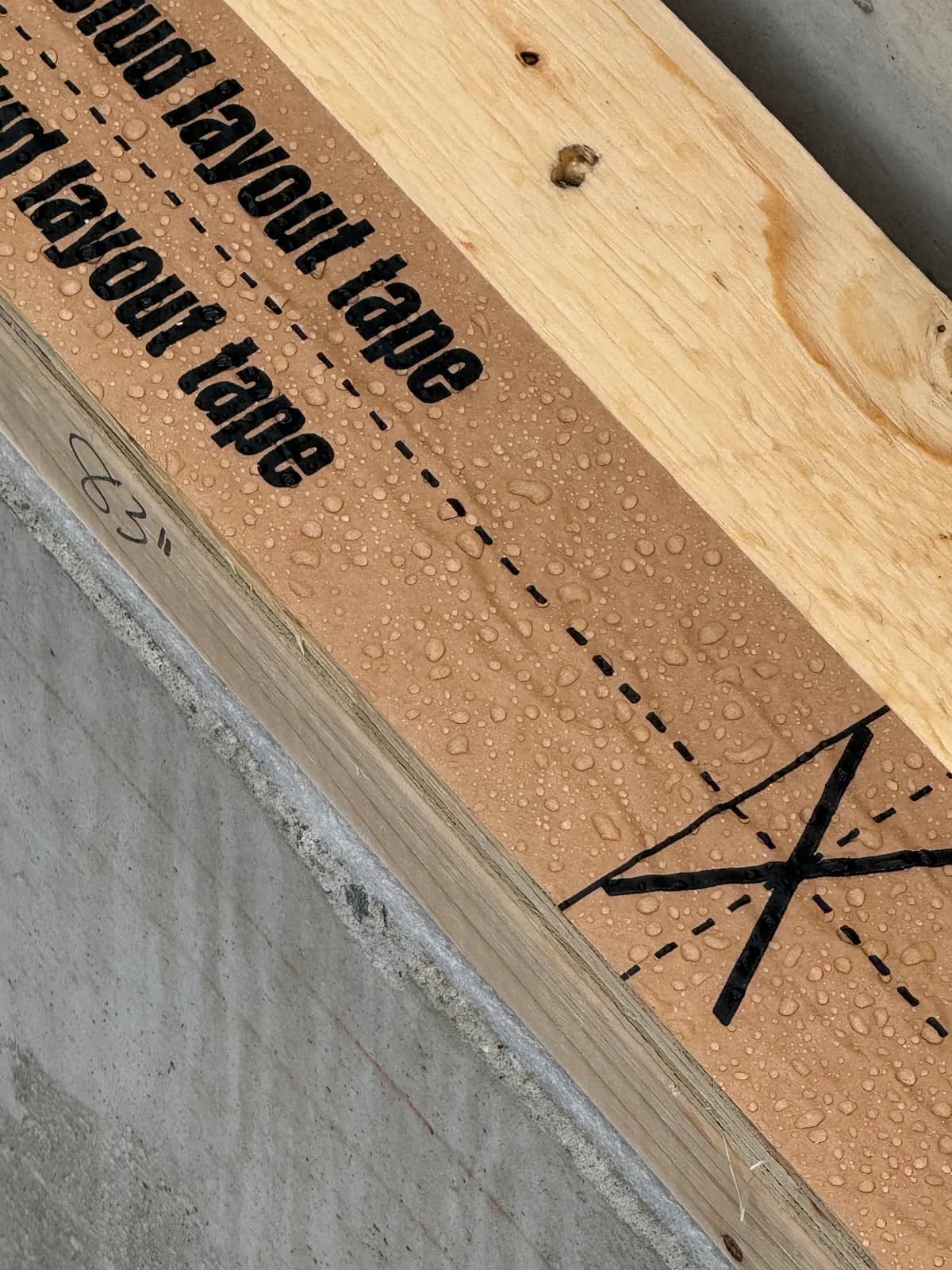
When you compare stud layout tape vs tape measure on a real wall plate, the tape measure still finds rough openings and odd dimensions, but it no longer does the repetitive marking. A pre-printed 16-inch on center tape lays every stud line in one pass, which changes who holds the pencil and how long that step takes on a Québec framing crew.
What Changes on a Québec Framing Job Site
On most residential and light commercial jobs in Québec, plates get marked at 16 inches on center, then checked against the plan for king studs, trimmers, and openings. A tape measure, pencil, and square do that job, but every mark is drawn by hand, one at a time, for every plate on the job. Stud layout tape changes that single step: the spacing is already printed on the tape, so the crew unrolls it along the plate instead of measuring and marking each line separately.
This does not remove the tape measure from the truck. It changes what the tape measure is used for on that plate.
Stud Layout Tape vs Tape Measure: The Core Difference
A tape measure is a general tool. It measures any length, any time, for any trade. A stud layout tape is a single-purpose tool built for one repeated task: marking studs at a fixed spacing on a wall plate or mud sill.
The 16-inch Stud Layout Tape (3″ roll) from X-Tape is printed with an X and a line at every 16 inches on center. Instead of measuring from zero and marking each stud by hand, the crew rolls the tape along the plate and the layout is already there. The product sold is the 16-inch Stud Layout Tape, 3″ × 164′ roll, built for stud layout on wall plates, along with the Stud Layout Tape Applicator and the Metal Stud Tape Applicator, both plastic tools that hold the roll while it is applied.
A 1 7/16-inch tape is in development and listed as coming soon. It is not available to buy yet, so any plate layout today uses the 3-inch roll.
Accuracy: What ±1/8″ Over 20′ Means for a Plate
Every roll of X-Tape is printed to a documented precision of plus or minus 1/8 inch over 20 feet. On a wall plate, that means the stud lines stay consistent across a long run without each one being re-measured and re-checked by hand. With a tape measure and pencil, accuracy depends on the person doing the marking, how the tape is held, and whether the pencil mark is centred on the line. Fatigue and repetition are where hand marking tends to drift over a full day of plates.
Where the Tape Measure Still Wins
Stud layout tape is built for one job: marking repeated stud spacing on plates and sills. It does not replace a tape measure for:
- Measuring rough openings for doors and windows
- Checking overall wall length or room dimensions
- Laying out anything that is not on a standard on-center spacing
- Any measurement where the spacing is not fixed at 16 inches
On a real job, both tools stay in the pouch. The tape measure handles variable measurements. The layout tape handles the repeated, fixed-spacing part of the job that used to take a pencil mark every 16 inches.
The Timed Comparison: What Was Actually Measured
X-Tape documents one timed comparison on its own site: marking a plate the traditional way, with tape measure, pencil, and square, took 1 minute 5.88 seconds. Marking the same plate with X-Tape took 5.36 seconds. This is a single documented comparison shown by X-Tape, not an independent study, and it should be read as one example of the marking step, not a general productivity claim for an entire framing job.
What it does show clearly: the step being compared is the marking step itself, not the whole wall-building process. Cutting, nailing, and raising the wall are unaffected by which tool marked the plate.
Water Resistance, Adhesion, and Where Not to Use It
The tape is water resistant and tears by hand, with high adhesion and low residue when removed. It is also biodegradable. These properties matter on a job site where plates sit outside, get rained on, or sit in a lumber pile before framing starts.
One limit matters for every crew: the tape must not be applied on finished surfaces. It is built for raw framing lumber, wall plates, and mud sills, not for finished walls, trim, or painted material.
Buying the Roll or Requesting a Bulk Order
The 16-inch Stud Layout Tape, 3″ × 164′ roll, is sold directly through xtapeofficial.com with Shopify checkout for Canada. Crews and building supply stores ordering in volume can request a bulk order by email instead of placing individual online orders. X-Tape is a trademark and the product is patent pending. For more on how the tape is used on different framing tasks, see the X-Tape blog.
Related reading:
Quick questions
YouIs there a real difference between a tape measure and a measuring tape?
X-TapeAs X-Tape explains, in everyday trade language, tape measure and measuring tape describe the same handheld tool used to measure length. The terms are used interchangeably on most job sites and in most hardware stores, so neither one is more correct than the other.
YouWhat does a stud mark mean on a tape measure?
X-TapeSome tape measures print a highlighted mark, often in red, at every 16 inches to flag common on-center stud spacing. It is a visual reference only, the person marking the plate still has to transfer that mark by hand with a pencil.
YouHow do you find a stud using only a tape measure?
X-TapeAccording to X-Tape, you measure from a fixed starting point, usually the end of the wall plate, and mark every 16 inches on center, squaring each line before cutting or nailing. This works but depends on careful, repeated measuring for every single stud on every plate.
YouCan stud layout tape fully replace a tape measure on a Québec framing site?
X-TapeNo. As X-Tape explains, stud layout tape replaces the repeated marking step for 16-inch on-center layout on wall plates and mud sills, but a tape measure is still needed for rough openings, wall lengths, and any non-standard spacing on a Québec framing job.